


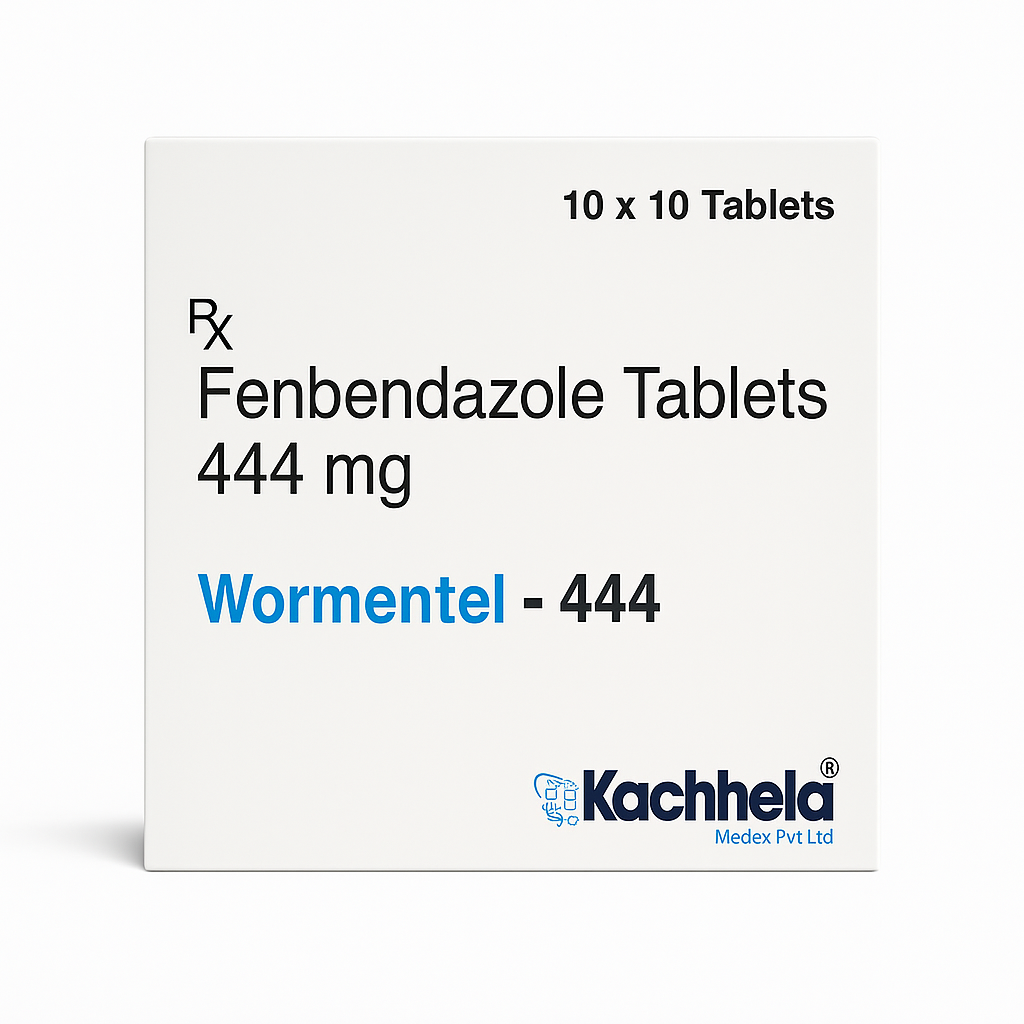

Fenbendazole 444 Mg
Price range: $36.00 through $125.00
| Active Ingredient: | Fenbendazole |
| Indication: | Treat a variety of parasites |
| Manufacturer: | Kachhela Medex Pvt. Ltd. |
| Packaging: | 10 tablets in 1 strip |
| Strength: | 444 mg |
| Delivery Time: | 6 To 15 days |
Fenbendazole 444 mg Tablets: Effective Treatment for intestinal Worm Infections
Introduction
In the modern digital world, information can be accessed in seconds. When people face serious or long-term health challenges, they often search widely—sometimes beyond conventional medicine—for answers, explanations, or hope. This has led to growing interest in medicines that were never designed for human use but appear frequently in online discussions.
One such medicine is Fenbendazole 444 mg, commonly sold under the veterinary brand name Wormentel 444 mg.
Fenbendazole has been safely used in animal health for decades as a deworming medication. However, in recent years, it has gained attention in human health discussions, especially on blogs, forums, and social media platforms. This attention has created confusion, misinformation, and unrealistic expectations.
What Is Fenbendazole 444 mg (Wormentel 444 mg)?
Fenbendazole is a synthetic antiparasitic drug belonging to the benzimidazole family. These medicines are designed to eliminate parasites—especially intestinal worms—in animals.
Wormentel 444 mg is a veterinary formulation containing Fenbendazole 444 mg as its active ingredient. It is commonly prescribed by veterinarians to treat worm infections in animals such as dogs, livestock, and horses.
Key Characteristics
- Broad-spectrum antiparasitic activity
- Intended strictly for veterinary use
- Acts at the cellular level in parasites
- Long history of animal use
Why Fenbendazole Was Developed Only for Animals
Medicines are developed for specific species because:
- Humans and animals metabolize drugs differently
- Safe doses vary greatly between species
- Human medicines require extensive clinical trials
Fenbendazole never underwent human clinical trials, not because it failed, but because it was never intended for humans. Without these trials:
- Safe human dosage is unknown
- Long-term effects are unclear
- Risks cannot be accurately measured
This is why regulatory authorities worldwide do not approve Fenbendazole for human use.
How Fenbendazole Works (Explained Simply)
To understand why Fenbendazole attracts attention, it helps to understand how it works biologically.
What Are Microtubules?
Inside every living cell are tiny structures called microtubules. They help cells:
- Maintain shape
- Divide properly
- Transport nutrients
Fenbendazole’s Action
Fenbendazole interferes with microtubules. In parasites:
- Glucose absorption is blocked
- Energy production stops
- The parasite weakens and dies
This mechanism makes Fenbendazole effective as a veterinary deworming agent.
Why Fenbendazole Appears in Human Health Discussions
Fenbendazole began appearing in human health conversations for several reasons:
1. Laboratory Research
Some laboratory studies examined Fenbendazole’s effect on cellular structures, sparking curiosity outside veterinary medicine.
2. Drug Repurposing Curiosity
Scientists often explore whether existing medicines have additional biological effects, leading Fenbendazole to be mentioned in experimental discussions.
3. Online Information Sharing
Blogs, forums, and social media amplify information—often without context—making Fenbendazole widely discussed.
4. Anecdotal Stories
Personal stories shared online can sound convincing, even though they are not scientific evidence.
5. Search for Hope
People dealing with serious or chronic illness may explore every possible option, increasing interest in unconventional topics.
Fenbendazole and Cancer Discussions (Important Clarification)
Fenbendazole, particularly in formulations like Wormentel 444 mg, has gained attention in online conversations related to cancer. This attention has often been fueled by laboratory studies, anecdotal stories, and internet discussions. It is crucial to understand what the research actually shows—and what it does not show—to avoid misconceptions or unsafe practices.
1. What Laboratory Research Shows
Laboratory studies (in test tubes or on cell cultures) have explored how Fenbendazole affects cells. Key points include:
- Microtubule disruption: Fenbendazole interferes with cellular structures called microtubules, which are essential for cell division and shape maintenance.
- Glucose metabolism: Some studies suggest it may affect how cells process glucose, particularly in rapidly dividing cells.
- Cellular stress response: Fenbendazole has been observed to create stress in lab-grown cells, which can lead to cell death under experimental conditions.
These studies are preliminary and are designed to understand mechanisms, not to establish a safe or effective human therapy.
2. What Research Does NOT Show
It is important to clearly state what Fenbendazole research does not confirm:
- No approved cancer treatment: Fenbendazole has not undergone human clinical trials for cancer.
- No proven efficacy in humans: Lab studies cannot predict real-world outcomes in patients.
- No dosage guidance: There is no safe or standardized dose for human use.
- No guarantee of safety: Potential side effects, interactions, and long-term consequences in humans are unknown.
3. Why People Misinterpret the Data
Several factors contribute to confusion:
- Anecdotal stories: Online personal experiences often get shared widely, even though they are not scientifically verified.
- Lab findings taken out of context: Observations in cells do not translate directly into human treatment.
- Desire for alternative solutions: Patients with serious illnesses may search for experimental options when conventional treatments seem limited.
This combination has led to widespread but inaccurate claims that Fenbendazole can treat or cure cancer in humans.
4. Risks of Using Fenbendazole for Cancer
Self-medicating with Fenbendazole is highly risky:
- Potential liver toxicity and organ strain
- Digestive disturbances like nausea, vomiting, and diarrhea
- Unknown drug interactions with chemotherapy or other medications
- Delayed proper medical treatment, which can worsen outcomes
- Allergic reactions or unexpected side effects
Because of these risks, any use outside of approved veterinary or research contexts is strongly discouraged.
5. Responsible Perspective
Fenbendazole should only be discussed in terms of research curiosity and cellular studies, not as a human treatment. Current scientific understanding emphasizes:
- Curiosity and research are not the same as treatment
- Laboratory effects do not equal proven human outcomes
- Safety and clinical evidence are critical before considering any drug for humans
Professional medical advice, evidence-based therapies, and FDA-approved treatments should always guide patient care.
Why Anecdotal Evidence Is Unreliable
Personal stories may feel powerful, but they:
- Are not controlled
- Often involve multiple treatments
- Cannot rule out placebo effects
- Cannot be verified
Medical science relies on controlled, repeatable studies, not individual experiences.
Potential Risks of Fenbendazole Use in Humans
Fenbendazole (Wormentel 444 mg) is a veterinary medicine not approved for humans, and using it carries several risks:
- Lack of Safety Data: No human clinical trials; safe dosage and long-term effects are unknown.
- Liver and Organ Stress: May strain the liver, kidneys, and other organs, especially in people with existing conditions.
- Digestive Side Effects: Possible nausea, vomiting, diarrhea, stomach pain, and loss of appetite.
- Unknown Long-Term Effects: Chronic exposure may affect metabolism, immunity, and organs.
- Drug Interactions: May interact unpredictably with blood thinners, antibiotics, chemotherapy, or liver-processed drugs.
- Pregnancy and Breastfeeding Risks: Safety in pregnant or breastfeeding women is unknown; may harm the baby.
- Allergic Reactions: Skin rashes, itching, swelling, or breathing difficulty may occur.
- Incorrect Dosage Risk: Veterinary tablets are not formulated for humans, increasing risk of overdose.
- Delay in Proper Treatment: Self-use can postpone correct diagnosis and proven medical therapy.
Benefits of Fenbendazole 444 mg in Humans
Fenbendazole 444 mg (Wormentel 444 mg) is a veterinary medicine and is not approved for human use. Therefore, there are no scientifically proven or officially recognized benefits for humans. Any discussion of potential effects is research-based or anecdotal, not medical advice.
Context in Human Discussions
- Laboratory Research Insights
- Studied in cell cultures for its effects on microtubules and cellular metabolism.
- Helps researchers understand cellular functions and drug mechanisms.
- Drug Repurposing Curiosity
- Explored experimentally to see if existing compounds may have additional biological effects.
- These studies are purely scientific and do not confirm safety or efficacy in humans.
- Anecdotal Observations (Unverified)
- Some online stories discuss personal experiences, but these are not controlled, verified, or reliable evidence.
Legal and Ethical Considerations
Medicines are regulated to:
- Protect public safety
- Ensure manufacturing quality
- Prevent misuse
Using veterinary medicine for humans bypasses these protections.
Storage Information (General Handling Awareness)
For informational awareness:
- Store at room temperature
- Keep away from heat and moisture
- Protect from sunlight
- Keep out of reach of children
Why Responsible Information Matters
Accurate health information:
- Prevents misuse
- Reduces harm
- Encourages evidence-based care
- Protects public trust
Misinformation can cause real-world damage.
Conclusion
Fenbendazole 444 mg (Wormentel 444 mg) is a well-established veterinary antiparasitic medication with decades of animal use. While it has gained attention in human health discussions, it is not approved for human use, and its safety and effectiveness in humans are not scientifically proven.Curiosity is natural, especially when people seek answers for serious health concerns. However, scientific evidence and medical guidance must always come before speculation. Using unapproved veterinary medicines for human health carries serious and unpredictable risks.When it comes to human health, the safest path is always approved treatments, qualified medical advice, and evidence-based care.
| Tablet |
100 Tablet ,200 Tablet ,300 Tablet ,500 Tablet |
|---|
Only logged in customers who have purchased this product may leave a review.





Reviews
Clear filtersThere are no reviews yet.